Transferring Company Shares in UAE — The Complete Legal Process

Selling part of your company, bringing in a new investor, or restructuring ownership sounds straightforward — until you realise that a share transfer in UAE is not as simple as signing a piece of paper and shaking hands.
In UAE, share transfers are legal transactions that require formal documentation, authority approval, and MoA amendments. Getting any part of the process wrong does not just delay the transfer — it can make the entire transaction legally invalid. And an invalid share transfer means the buyer has no legal claim to the shares they paid for.
This guide explains exactly how share transfers work in UAE — who needs to do what, which documents are required, which authority gives approval, and how long the process takes. Whether you are buying shares, selling shares, or restructuring your company's ownership, this guide tells you everything you need to know before you start.
What is a share transfer in UAE?
Before you can transfer shares, it helps to understand what shares actually represent in a UAE company context.
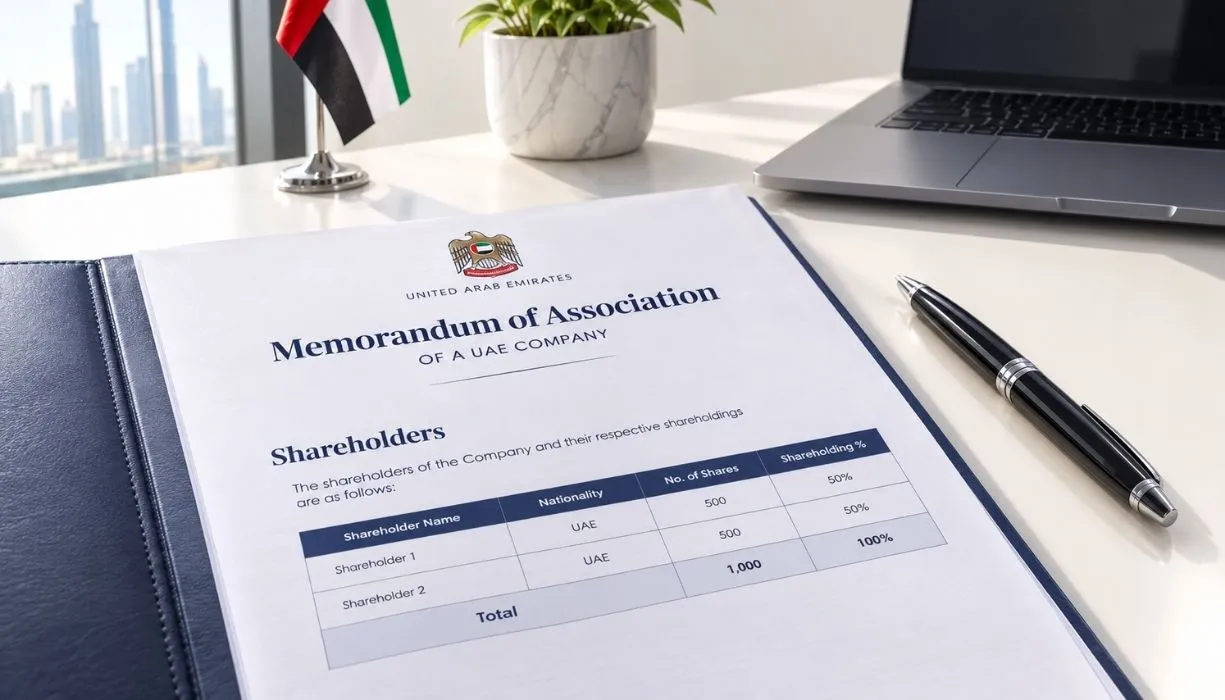
In a UAE Limited Liability Company — LLC — the company's capital is divided into shares. Each share represents a percentage of ownership in the company. When a shareholder transfers their shares to another person or entity, they are legally transferring their ownership stake — along with the rights, profits, and liabilities that come with it.
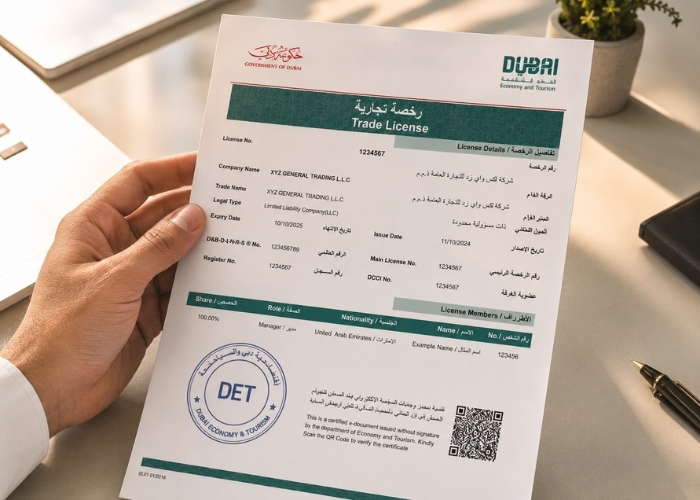
A share transfer is not an internal company decision. It is a change to the company's legal structure that must be formally recorded in the company's Memorandum of Association — MoA — and approved by the relevant government authority. Until the authority approves the transfer and issues an updated trade license, the new shareholder has no legal standing in the company.
This is the part that catches many business owners off guard. The agreement between buyer and seller is just the starting point — the legal process of formalising that agreement with the UAE authorities is what completes the transfer.
Who can transfer shares in a UAE company?
Not every shareholder can transfer their shares freely — and knowing the restrictions before you start saves significant time and legal cost.
In a UAE mainland LLC, shares can be transferred to existing shareholders, new individual investors, or corporate entities. However, the MoA often contains pre-emption rights — meaning existing shareholders have the right of first refusal before shares can be offered to an outsider. If your company MoA includes pre-emption clauses, you must follow the correct process for offering shares to existing shareholders before approaching external buyers.
In free zone companies, the rules vary by zone. DMCC, JAFZA, IFZA, and other major free zones each have their own share transfer procedures and documentation requirements. Some free zones require the incoming shareholder to meet specific eligibility criteria — particularly for regulated activity categories.
Foreign nationals can own shares in both mainland and free zone companies. Since the 2021 amendment to the UAE Commercial Companies Law, foreigners own 100% of most mainland LLC companies. This means share transfers to foreign buyers are permitted for most activities. However, a small number of restricted activities in strategic sectors still limit foreign ownership — your legal consultant should confirm whether your activity falls into this category before proceeding.
What documents do you need for a share transfer in UAE?
The documentation required for a share transfer depends on whether the company is a mainland LLC or a free zone entity — and whether the incoming shareholder is an individual or a corporate entity.
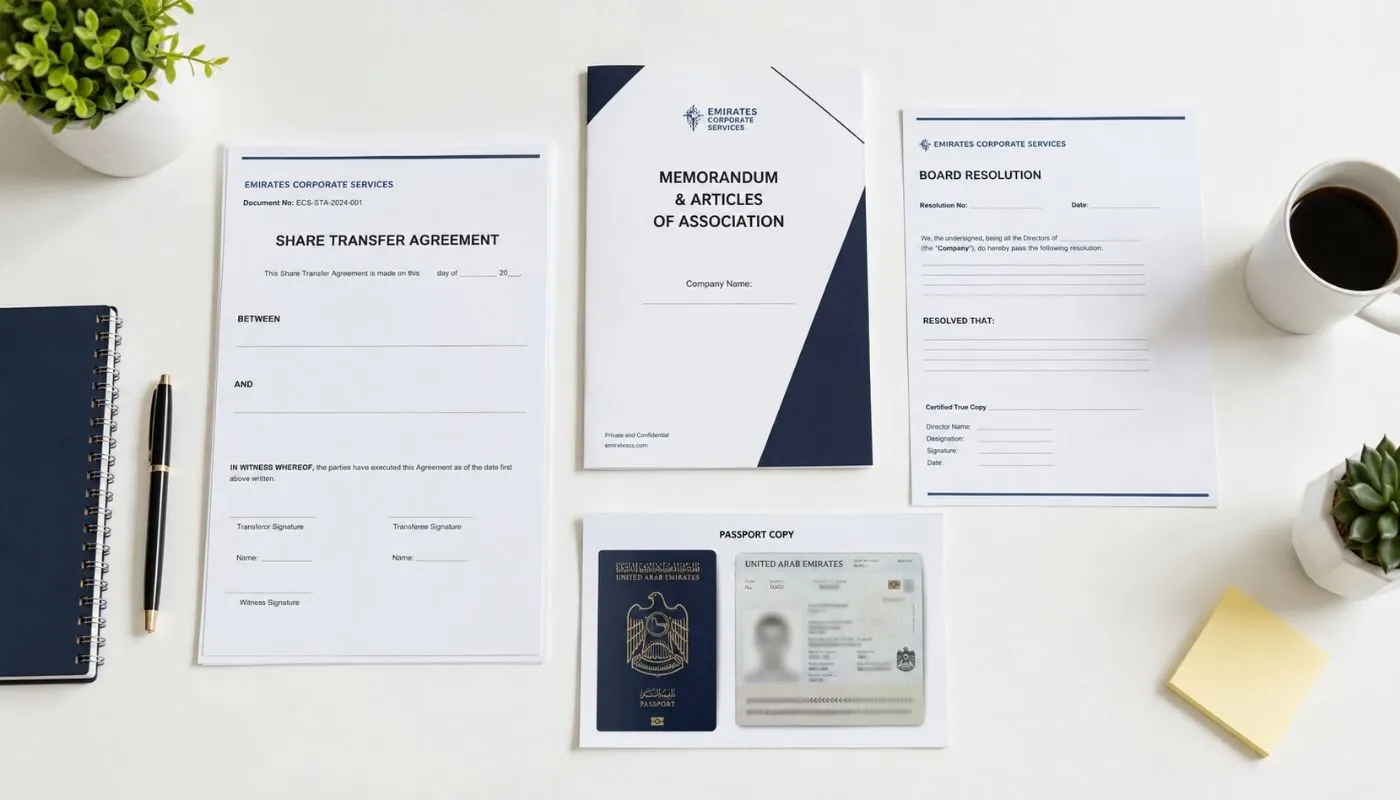
For a standard mainland LLC share transfer between individuals, the core documents required are:
- A share transfer agreement signed by both the seller and the buyer — this is the primary legal document recording the terms of the transfer including the number of shares, transfer price, and effective date.
- A board resolution from the existing shareholders approving the transfer — this confirms that the company's shareholders have formally agreed to the ownership change.
- An updated Memorandum of Association — the MoA must be amended to remove the selling shareholder's details and add the buying shareholder's details with the correct shareholding percentages. This is a registration amendment that must be filed with the relevant authority.
- Passport copies of all current and incoming shareholders — valid passport with minimum six months validity.
- Emirates ID copies of all UAE resident shareholders.
- A No Objection Certificate — NOC — from the incoming shareholder's current UAE sponsor if they are on a UAE employment visa.
For corporate shareholders, additional documents are required. These include the corporate shareholder's certificate of incorporation — attested — the corporate shareholder's MoA — attested — and a board resolution from the corporate shareholder authorising the investment in your UAE company.
⚠️ Important — Attestation Requirement
All foreign documents used in a UAE share transfer must be attested. This means the documents must carry an official authentication stamp — either through the UAE Embassy in the document's country of origin or through an Apostille certification if the country is a party to the Hague Convention. Unattested foreign documents are rejected by UAE authorities.
The step-by-step share transfer process in UAE
Here is exactly what happens from the moment a buyer and seller agree on a transfer to the moment the updated trade license is in hand.
Agree the transfer terms and prepare the share transfer agreement
The first step is agreeing the terms — number of shares, transfer price, payment terms, and effective date — and recording these in a formal share transfer agreement. This document is drafted by a legal consultant and signed by both parties. It is the foundation of the entire transfer — everything else flows from this agreement.
If your company MoA contains pre-emption rights, the seller must formally offer the shares to existing shareholders first — in writing, at the agreed price — and allow the required waiting period before proceeding with an external buyer.
Prepare the board resolution
Once the share transfer agreement is signed, a board resolution must be prepared approving the transfer. For mainland LLCs, this resolution is signed by all shareholders. For free zone companies, the resolution format and signatories depend on the specific free zone's requirements.
Prepare the updated Memorandum of Association
The MoA must be amended to reflect the new shareholding structure. The updated MoA replaces the existing one and must state the new shareholding percentages clearly. This document is prepared by a legal consultant and must meet the exact formatting and content requirements of the relevant authority — DET for mainland companies, or the specific free zone authority.
Notarisation
For mainland LLC share transfers in Dubai, the updated MoA must be notarised at a UAE Notary Public before submission to DET. This is a mandatory step — an unnotarised MoA is not accepted by DET. The notarisation process involves presenting the updated MoA and all shareholder documents to the Notary Public, who verifies the document and applies the official notarial seal.
Authority submission and approval
The complete package — share transfer agreement, board resolution, updated MoA, and all supporting documents — is submitted to the relevant authority. For mainland companies this is DET Dubai, ADDED Abu Dhabi, or SEDD Sharjah depending on where the company is registered. For free zone companies, the submission goes to the specific free zone authority — DMCC, JAFZA, IFZA, SHAMS, or RAKEZ.
The authority reviews the submission, verifies all documents, and issues the updated trade license reflecting the new shareholding structure.
Updated trade license and documents delivered
Once the authority approves the transfer, the updated trade license is issued with the new shareholder's name and shareholding percentage recorded. The company's official documents are updated and delivered to all parties.
How long does a share transfer take in UAE?
Timeline is one of the most common questions — and the answer depends on how quickly the documents are prepared and whether all parties cooperate promptly.
| Transfer Type | Typical Timeline |
|---|---|
| Mainland LLC — individual to individual | 7–14 working days |
| Mainland LLC — corporate shareholder addition | 14–21 working days |
| DMCC / JAFZA free zone transfer | 5–10 working days |
| IFZA / SHAMS / Ajman Free Zone | 3–5 working days |
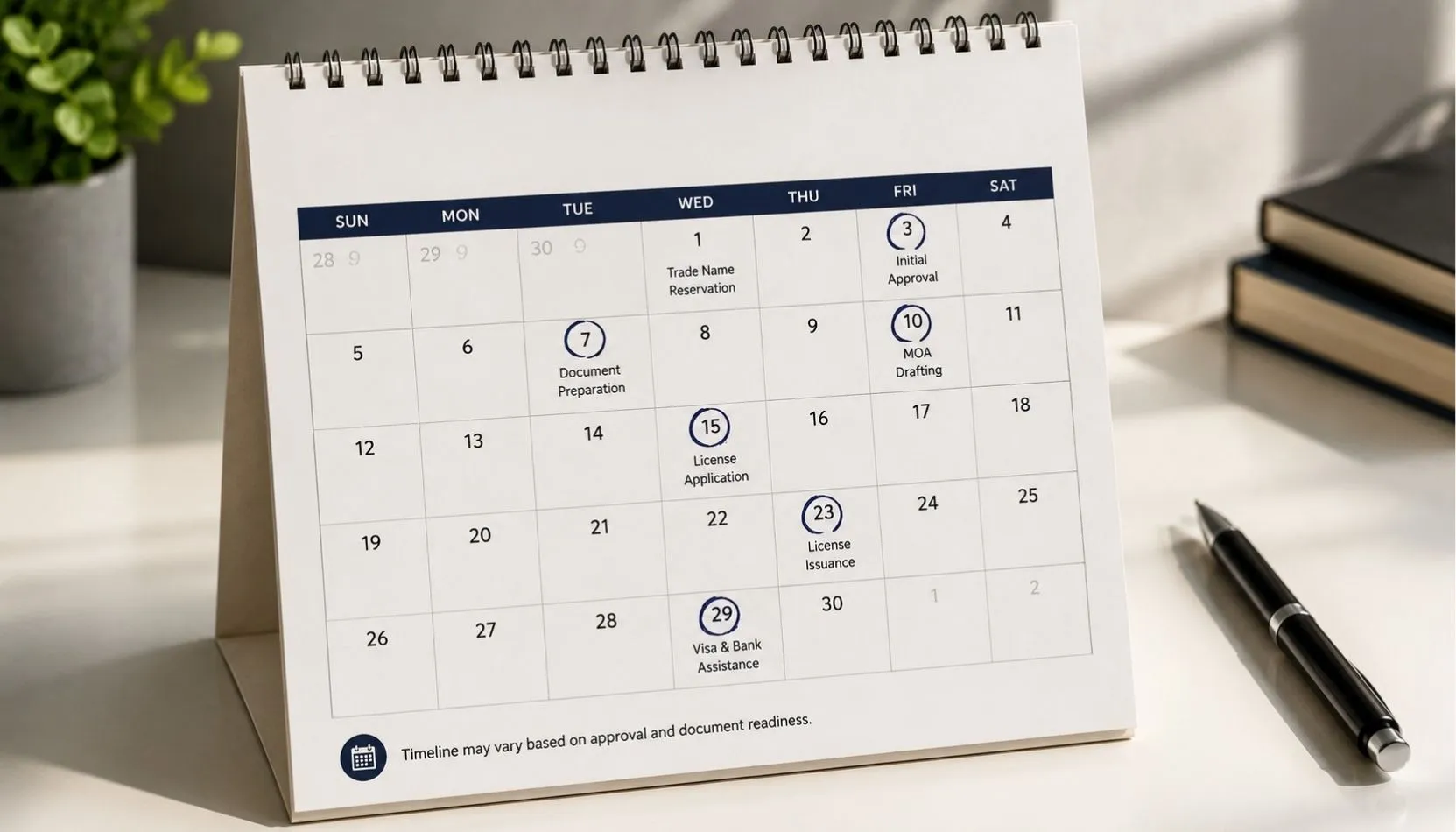
One point worth noting: the timeline clock starts when all documents are correctly prepared and submitted — not when the buyer and seller sign the share transfer agreement. Incomplete submissions or incorrect documents reset the timeline. Working with an experienced consultant who knows exactly what each authority requires is the most reliable way to avoid delays.
Common mistakes that delay share transfers in UAE
Most share transfer delays are caused by the same avoidable mistakes. Knowing what they are before you start saves significant time and cost.
- Incorrect or unattested foreign documents is the most common delay. Corporate shareholders and foreign individuals often submit documents that have not been correctly attested for UAE use. DET and free zone authorities reject unattested documents without exception — and the entire submission must be restarted.
- Missing pre-emption rights process causes transfers to be challenged after completion. If your MoA includes pre-emption rights and you did not follow the correct process before selling to an external buyer, existing shareholders can legally challenge the transfer.
- Incorrect MoA format for the relevant authority is another common issue. DET Dubai, DMCC, JAFZA, and other authorities each have specific MoA formatting requirements. An MoA prepared to DET's format is rejected by DMCC and vice versa.
- Transferring shares in a company with outstanding liabilities — if the company has unpaid fines, expired licenses, or outstanding government fees, the authority blocks the share transfer until all liabilities are cleared. Checking the company's liability status before starting the transfer process prevents this delay.
What happens to visas when shares are transferred?
This question comes up in every share transfer — and the answer depends on what type of visas are involved.
Employee visas sponsored by the company are not affected by a share transfer. They remain valid under the company's sponsorship regardless of who the shareholders are. Employees do not need to re-apply for visas simply because ownership has changed.
Investor visas are directly tied to the shareholding structure. If the selling shareholder holds an investor visa based on their shareholding percentage, that visa must be cancelled as part of the transfer process. The incoming shareholder applies for a new investor visa based on their shareholding in the updated MoA. Our PRO services in Dubai team handles all visa adjustments alongside the share transfer process.
If the selling shareholder's investor visa minimum threshold — typically 50% or more of company shares — drops below the required percentage, the visa category changes. Your PRO consultant should be involved in the share transfer process from the beginning to ensure all visa adjustments are handled correctly and no one is left on an invalid visa status.
Can Modest Consulting Services manage your share transfer?
Yes. Modest Consulting Services FZE handles the complete share transfer process for mainland and free zone companies across all UAE jurisdictions — from drafting the share transfer agreement and MoA amendment to notarisation, authority submission, and updated license delivery.
We manage share transfers for companies registered with DET Dubai, ADDED Abu Dhabi, SEDD Sharjah, DMCC, JAFZA, DAFZA, Dubai South, IFZA, SHAMS, Ajman Free Zone, and RAKEZ.
Every share transfer is managed by one dedicated consultant who knows your company's structure and coordinates all documentation, notarisation, and authority submission on your behalf — so the transfer is completed correctly and in the shortest possible time.
Call or WhatsApp us on +971 56 404 5802 for a free consultation.
Frequently asked questions about share transfers in UAE
A mainland LLC share transfer between individuals takes 7–14 working days from the date all documents are correctly prepared and submitted. Free zone transfers take 5–10 working days depending on the authority.
You do not need a lawyer but you do need a qualified legal consultant or company formation specialist who knows the specific requirements of the relevant authority. Errors in documentation are costly and time-consuming to correct. Modest Consulting Services manages share transfers end to end — contact us on +971 56 404 5802.
Yes. Since the 2021 UAE Commercial Companies Law amendment, foreigners can own 100% of most mainland companies through share transfer. A small number of restricted activities in strategic sectors still limit foreign ownership. Modest Consulting Services confirms whether your activity has any restrictions before starting the transfer.
The cost includes government authority fees and professional service fees. Government fees vary by emirate and authority. Modest Consulting Services provides a fixed written quote before any work begins — contact us for a quote specific to your company and jurisdiction.
Yes. Share transfers are available for all major UAE free zone companies — DMCC, JAFZA, DAFZA, IFZA, SHAMS, Ajman Free Zone, and RAKEZ. Each free zone has its own transfer procedure and documentation requirements. Modest Consulting Services manages free zone share transfers for all major UAE zones.
Need to transfer shares in your UAE company?
Modest Consulting Services FZE manages the complete share transfer process — documentation, notarisation, authority submission, and updated license delivery — for mainland and free zone companies across all UAE jurisdictions.
modest-uae.ae